Best HDFC Bank Credit Cards in 2026: Top 5 Picks Compared
11 February 2026 · BestCard Editorial Team
HDFC Bank runs the widest, deepest credit card lineup of any Indian issuer — from free entry-level cards to a metal Infinia that regularly tops "best card in India" lists. That breadth is also HDFC's biggest weakness for a new applicant: there are dozens of variants, and picking the wrong one means paying an annual fee for benefits you'll never touch. HDFC's underwriting also leans conservative and relationship-driven, so existing HDFC banking customers typically get better approval odds and stronger pre-approved offers than someone applying cold.
This is a practical shortlist of the five HDFC cards that best represent the bank's real strengths: a super-premium travel card, a mid-tier travel/dining card, an everyday cashback-style card, and two co-brand cards built around specific spend patterns (Tata's retail ecosystem and food delivery). If you're deciding which HDFC card is worth applying for, start here.
HDFC Infinia (Metal Edition)
Joining fee: ₹12,500 + GST · Annual fee: ₹12,500 + GST (waived on ₹10,00,000 annual spend)
Reward rate: 5 reward points per ₹150 spent (worth roughly 3.33% base value), with an effective rate up to 16.65% on travel bookings through the SmartBuy portal when transfer and redemption multipliers stack.
Best for: High-spending frequent flyers who want the single strongest travel redemption engine in the Indian market, unlimited airport lounge access, and golf privileges, and who can comfortably clear the ₹10 lakh annual spend needed to waive the fee.
Infinia is India's benchmark premium metal card for a reason — the points-to-airmile transfer ratios and lounge network are genuinely best-in-class, and HDFC prices it to filter for high spenders rather than to be broadly accessible. Our honest take: unless you're spending well into six figures monthly and actually redeem points for international business-class transfers, you're paying for headroom you won't use — read our full HDFC Infinia review before applying, and compare it directly against the Tata Neu co-brand in our Tata Neu Infinity vs HDFC Infinia breakdown.
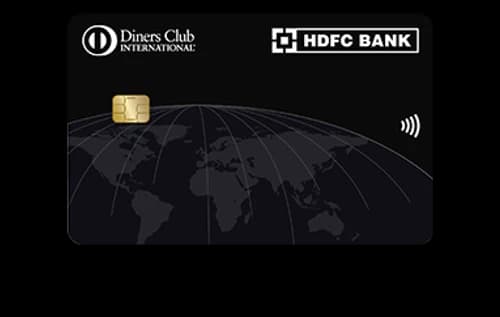
HDFC Diners Club Black (Metal Edition)
Joining fee: ₹10,000 + GST · Annual fee: ₹10,000 + GST (waived on ₹8,00,000 annual spend)
Reward rate: Up to 16.65% effective reward rate on dining spend through SmartBuy offers, with unlimited domestic and international lounge access and golf benefits similar to Infinia.
Best for: Someone who wants Infinia-tier lounge and lifestyle benefits but skews spending toward dining and lifestyle categories rather than pure travel, at a slightly lower fee and waiver threshold.
Diners Club Black is HDFC's second premium metal tier, and for a lot of applicants it's the more realistic target than Infinia — the waiver spend is meaningfully lower while the day-to-day perks (lounge access, concierge, dining privileges) are nearly identical. It's a strong card if your spend is dining- and lifestyle-heavy rather than travel-heavy. See our HDFC Diners Club Black review for the full benefit breakdown, and our HDFC Diners Club Premium review if you want to compare against the step-down variant.
HDFC Regalia Gold
Joining fee: ₹2,500 + GST · Annual fee: ₹2,500 + GST (waived on ₹4,00,000 annual spend)
Reward rate: 4% on dining, 4% on groceries (capped monthly), 2.5% on travel spend.
Best for: Someone who wants meaningful travel and lifestyle benefits — airport lounge access, a reasonable rewards rate on dining and groceries — without stepping up to a ₹10,000+ annual fee card.
Regalia Gold sits in the sweet spot between HDFC's entry-level cashback cards and its metal premium tier: a genuinely useful mid-range travel card with a fee that's easy to justify for someone spending a few lakhs a year. It's the card we'd point most salaried professionals toward if Infinia and Diners Club Black feel like overkill. Full detail in our HDFC Regalia Gold review — and if you're deciding between Regalia Gold and the older Regalia, we've also reviewed the classic HDFC Regalia separately.
HDFC Millennia
Joining fee: ₹1,000 + GST · Annual fee: ₹1,000 + GST (waived on ₹1,00,000 annual spend)
Reward rate: 5% cashback-equivalent on online shopping (capped ₹1,000/month), 2.5% on groceries (capped ₹500/month), and 1% on virtually all other retail spend.
Best for: Anyone who wants a genuinely low-fee card that still rewards nearly every category of everyday spending, rather than one bonus category surrounded by categories earning nothing.
Millennia is HDFC's best-value everyday card by a clear margin — the 1% floor rate on general spend is what most competing entry cards fail to offer, and the fee waiver threshold of ₹1 lakh is achievable for almost anyone with a salary account. If you want one HDFC card and don't care about lounge access, this is usually it. Read our full HDFC Millennia review for the complete category breakdown.
Tata Neu Infinity HDFC Bank Card
Joining fee: ₹1,499 + GST · Annual fee: ₹1,499 + GST (waived on ₹3,00,000 annual spend)
Reward rate: 5% NeuCoins back on both online shopping and utility bill payments — utilities being a category most cards reward poorly or skip entirely.
Best for: Households that already shop across the Tata retail ecosystem (BigBasket, Croma, Tata CLiQ, Tata 1mg) and want their utility bill payments to actually earn something.
This is HDFC's strongest co-brand play, riding on Tata's retail footprint rather than HDFC's own merchant network. The flat 5% on utilities is genuinely rare — most premium travel cards reward utilities at 1% or less — which makes this a smart secondary card even for someone who already carries an HDFC Infinia or Regalia Gold for travel. Compare it against the SBI equivalent in our dedicated guide below, and read the full Tata Neu Infinity HDFC Bank Card review for redemption mechanics.
How the five HDFC cards compare
| Card | Annual fee | Best for |
|---|---|---|
| HDFC Infinia | ₹12,500+GST | Premium travel, high spenders |
| HDFC Diners Club Black | ₹10,000+GST | Premium lifestyle/dining, lower waiver spend |
| HDFC Regalia Gold | ₹2,500+GST | Mid-tier travel/dining without metal-card fees |
| HDFC Millennia | ₹1,000+GST | Everyday spend across all categories |
| Tata Neu Infinity HDFC | ₹1,499+GST | Tata ecosystem shoppers, utility bill payers |
The decision usually comes down to your annual spend, not your income. If you can't realistically clear ₹8-10 lakh a year on the card, Infinia and Diners Club Black are a net loss — the annual fee simply isn't worth carrying for lounge visits you make twice a year. Millennia or Regalia Gold cover the vast majority of applicants better, and the Tata Neu co-brand is worth adding as a second card if you shop that ecosystem regularly.
For a side-by-side against other issuers, see our HDFC vs SBI credit cards and HDFC vs ICICI credit cards comparisons, or run your own numbers through our card matching tool to see which HDFC card actually fits your spend pattern. You can also browse HDFC's full lineup on our HDFC credit cards guide.
Frequently asked questions
Which HDFC credit card gives the best rewards for everyday spending?
HDFC Millennia is the strongest all-rounder for everyday spend — 5% back on online shopping (capped) and 1% on nearly every other retail category, for a modest annual fee that's easy to waive.
Is HDFC Infinia worth the annual fee?
Only if you can consistently spend enough to clear the annual waiver threshold and actually use the airport lounge and travel-transfer benefits — otherwise a Diners Club Black or Regalia Gold gives most of the value at a fraction of the cost.
Does HDFC have a good card for Tata ecosystem or Swiggy spending?
Yes — the Tata Neu Infinity HDFC Bank Card and the Swiggy HDFC Bank Card are both co-brand cards built specifically around those merchant ecosystems, and both beat HDFC's general-purpose cards for spend within those categories.