
Standard Chartered EaseMyTrip Credit Card Review: Cheap to Hold, Strong on One App
17 March 2026 · BestCard Editorial Team
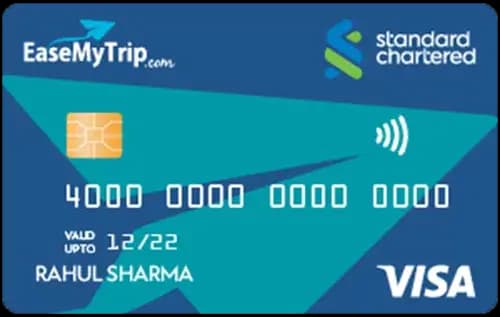
The Standard Chartered EaseMyTrip Credit Card is a low-fee travel co-brand with a very specific deal: book your flights and hotels on EaseMyTrip and you get a flat discount plus accelerated reward points. Step outside that one platform and the card turns ordinary quickly. That's not a criticism so much as a description of what it is. If EaseMyTrip is already where you book, the card is cheap enough that it almost has to pay for itself. If you book directly with airlines or across several apps, there are better travel cards.
Fees and eligibility at a glance
The joining fee and the annual fee are both ₹350, and the annual fee is waived once you spend ₹50,000 in a year. That's about ₹4,200 a month, a bar most people will clear just by putting a couple of trips on the card. Eligibility asks for a credit score of 700 or more, and the age range is unusually wide, from 18 to 65, for both salaried and self-employed applicants. It's a Visa card, and EMI conversion is available on transactions of ₹2,000 or more.
Rewards and how they actually work
You earn 10X reward points per ₹100 spent on EaseMyTrip flight and hotel bookings, and 2X on other retail spends. In other words, an EaseMyTrip booking earns five times the points of an ordinary swipe. Points can be redeemed for statement credit or vouchers with no redemption fee, which is a nice change from the ₹99-plus-GST charge many banks levy per redemption.
The card is honest about where its value sits. Outside EaseMyTrip, the 2X earn is modest, and you won't want to run groceries, dining or fuel through it if you hold a decent cashback card. Think of the points as a bonus on top of the booking discounts, not as the main event.
Booking discounts, lounges and the small print
The discounts are the strongest part of the package. You get a flat 20% off hotel bookings on EaseMyTrip, capped at ₹5,000 on domestic and ₹10,000 on international bookings, and a flat 10% off flight bookings with the same ₹5,000 domestic and ₹10,000 international caps. On a ₹12,000 domestic return flight, that's ₹1,200 off. On an ₹18,000 hotel stay, it's ₹3,600 off. A single trip can return several times the annual fee, which is what makes the card worth considering at all.
Lounge access is thin. You get 2 complimentary domestic lounge visits per calendar year, plus 2 international lounge visits through Priority Pass. That covers one return domestic trip, nothing more. The forex markup isn't published for this card, so don't rely on it for overseas spending until you've checked the current schedule of charges. Cash withdrawals cost 2.5% of the amount or ₹500, whichever is higher.
How it compares with PNB EaseMyTrip and AU ixigo
The closest rival is the PNB EMT RuPay Platinum Credit Card, another EaseMyTrip co-brand. It costs ₹2,000 a year, waived on ₹1 lakh of spend, and charges a 3.5% forex markup. In exchange it gives a ₹3,000 welcome voucher plus 300+ reward points, 10% off EaseMyTrip flights, discounts on hotels and buses, and insurance cover of up to ₹2 lakh. The Standard Chartered card is far cheaper to hold and its 20% hotel discount is more generous, so unless the PNB welcome voucher swings it for you, the SC card is the easier pick.
The AU Small Finance Bank ixigo Credit Card is the alternative if you're not tied to EaseMyTrip. It's lifetime free with zero forex markup, gives up to 10% off flight, bus and hotel bookings on ixigo, and has a wider lounge mix including railway lounges, though its domestic airport lounges are spend-gated. For anyone who also travels abroad, ixigo is the stronger all-round travel card.
What's genuinely good about this card
The flat 10% and 20% discounts are simple and immediate, and a single hotel booking can be worth more than a year of fees. The ₹350 fee is among the lowest you'll find on a travel card, and the ₹50,000 waiver threshold is easy. No redemption fee on points is a small but real plus. The wide 18 to 65 age range also makes it accessible to younger applicants and to older travellers who may struggle with income-based eligibility on other cards.
Where it falls short
Almost everything depends on EaseMyTrip. If prices on another platform or the airline's own site are lower for a given trip, the discount may not close the gap, and you'll be tempted to book where the card works rather than where the fare is cheapest. Two domestic lounge visits a year is a token allowance. The 2X earn outside EaseMyTrip is weak, and the unpublished forex markup makes it a gamble for international spending.
Who this card actually makes sense for
This card suits people who already book flights and hotels through EaseMyTrip a few times a year and want a cheap card to stack discounts on those bookings. Keep it as a dedicated booking card alongside a cashback card for everyday spend and a low-forex card for trips abroad. If you rarely use EaseMyTrip, there's little reason to hold it.
Where to go from here
For Standard Chartered's wider range, read the Standard Chartered credit cards guide, and for the bank's premium option, our Standard Chartered Ultimate review. If you're shopping for a booking card specifically, see the best credit cards for domestic flight bookings and the best credit cards for budget hotel bookings.
Related reading
- Standard Chartered Ultimate Credit Card Review
A high reward-rate card from a foreign bank with a limited India footprint. Here's when that tradeoff makes sense.
- KrisFlyer SBI Card Review: Worth It for Occasional Singapore Airlines Flyers?
A review of the KrisFlyer SBI Card's direct miles earning, lounge access, and fees for Singapore Airlines and Scoot flyers.
- IRCTC SBI Card Review: A Narrow Card That Does One Job Well
An honest review of the IRCTC SBI RuPay Card: the IRCTC transaction-charge waiver, its simple 1:1 reward points, low fees, and why it works as a companion card rather than a primary one.