
Axis Horizon Credit Card Review: The Mid-Tier Travel Card With Serious Lounge Access
27 May 2026 · BestCard Editorial Team
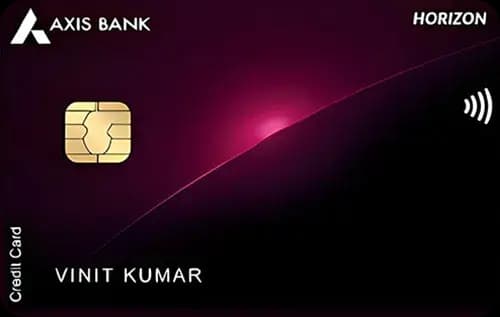
The Axis Horizon Credit Card is Axis's mass-market travel-miles card, positioned as the successor to the discontinued Citi PremierMiles. The idea is simple: earn EDGE Miles quickly on travel bookings, transfer them 1:1 to airline and hotel partners, and get far more lounge access than a ₹3,000 card usually offers. Outside travel it is a plain card, so whether Horizon works for you depends almost entirely on how often you fly and how you book.
Fees and eligibility at a glance
Horizon charges a ₹3,000 joining fee and a ₹3,000 annual fee, waived on ₹3.5 lakh of annual spend. That's under ₹30,000 a month, one of the easier waiver targets among Axis's travel cards. The listed minimum credit score is 700, and both salaried and self-employed applicants aged 18 to 70 can apply. The forex markup is 3.5%, the same as most mid-tier cards, which is awkward for a travel product and something we'll come back to.
Rewards and how they actually work
Horizon earns EDGE Miles. Travel bookings made through the Travel EDGE portal or directly with airlines earn at an accelerated 5x rate, which the card data puts at 5% in value terms. Everything else earns a flat 2%. There are no other bonus categories and no milestone rewards for higher spending.
Miles really pay off when you transfer them. Horizon's EDGE Miles move 1:1 to several travel partners through Travel EDGE, including Singapore Airlines KrisFlyer, Marriott Bonvoy and Accor Hotels, and Axis charges no fee for those transfers. If you're comfortable finding award seats or hotel redemptions, that is how you get the most out of the card. If you would rather have cash back, a flat cashback card will be simpler and probably better value.
Lounge access and travel perks
The lounge allowance is Horizon's headline feature. The Visa variant includes up to 8 complimentary domestic lounge visits per quarter (6 on the Mastercard variant), or up to 32 a year, plus 2 international lounge visits per quarter through Priority Pass, for 8 a year. That's a lot for a mid-tier fee. A couple travelling together several times a year can use it without running out. Horizon also includes complimentary travel insurance covering trip delay and baggage loss, fraud and card-loss protection, Axis's EazyDiner and Dining Delights restaurant discounts, and a 1% fuel surcharge waiver at fuel stations across India.
How it compares with Axis Atlas and Select
Axis Atlas is the obvious comparison. Both earn 5% on travel and 2% elsewhere, both have a 3.5% forex markup, and both earn transferable EDGE Miles. Atlas costs ₹5,000 with no spend-based waiver, but it adds a 2,500 EDGE Miles welcome bonus and tiered milestones, including 30,000 EDGE Miles and a tier upgrade at ₹3 lakh of annual spend. Its lounge access starts lower, at 8 domestic and 4 international visits a year at the Silver tier, and rises only with higher spend. If you spend ₹3 lakh or more a year and value milestone miles, Atlas usually comes out ahead. If you mostly want lounge visits and a waivable fee, Horizon is the better deal.
Axis Select costs the same ₹3,000 but is a points card with golf, a Swiggy discount and up to 12 Priority Pass visits a year, while its domestic lounge access is gated behind a quarterly spend condition. Select is a lifestyle card. Horizon is a travel card.
What's genuinely good about this card
The lounge allowance of up to 40 combined visits a year is hard to match at this fee, and the ₹3.5 lakh waiver means a moderate spender may never pay the fee at all. The 1:1 transfer to partners like KrisFlyer and Marriott Bonvoy, with no transfer fee, gives the miles real upside for anyone willing to learn award redemptions. The included travel insurance is a useful extra that cheaper travel cards often leave out.
Where it falls short
The 3.5% forex markup is the biggest contradiction. A card built for travellers charges a high fee on overseas spending, which wipes out much of what you earn on international purchases. Outside travel bookings, the 2% base rate has no accelerators, so Horizon won't be the best card for groceries, dining or online shopping. And unlike Atlas, there's no welcome bonus or milestone reward, so heavy spenders get no extra return for spending more.
Who this card actually makes sense for
Horizon suits domestic flyers who travel several times a year, book flights through airline sites or Travel EDGE, and want generous lounge access without committing to a ₹5,000 fee. It works well alongside a low-forex card for overseas spending and a cashback card for everyday purchases. If you spend heavily and chase milestones, Atlas is worth the extra cost. If you rarely fly, Horizon's main strengths won't matter to you.
Where to go from here
For the step-up option, read our Axis Atlas review, and for how Axis's travel cards compare, see best Axis credit cards for travel. If you plan to transfer miles, the guide to transferring reward points to airline miles is a good primer. To avoid the forex problem, pair Horizon with one of the best low forex markup credit cards.
Related reading
- Axis Bank Miles & More Card Review: Direct Lufthansa Miles, Worth ₹3,500?
How Axis Miles & More's direct Lufthansa Miles & More earning, lounge access, and low forex markup stack up against the ₹3,500 annual fee.
- IndiGo Axis Bank Premium Credit Card Review: Worth the Step Up From the Base Card?
The premium IndiGo Axis co-brand card adds lounge access and a 7% BluChips rate for a ₹5,000 fee — here's who that trade actually favors.
- Axis Bank Olympus Card Review: Worth Chasing the ₹20,000 Fee?
A look at the Axis Olympus's uncapped lounge access, recurring Taj/ITC vouchers, and strong mile-transfer ratio — and who can actually get one.