
Axis vs IDFC FIRST Credit Cards: Zero Forex Everywhere Against Axis's Flagships
3 November 2026 · BestCard Editorial Team
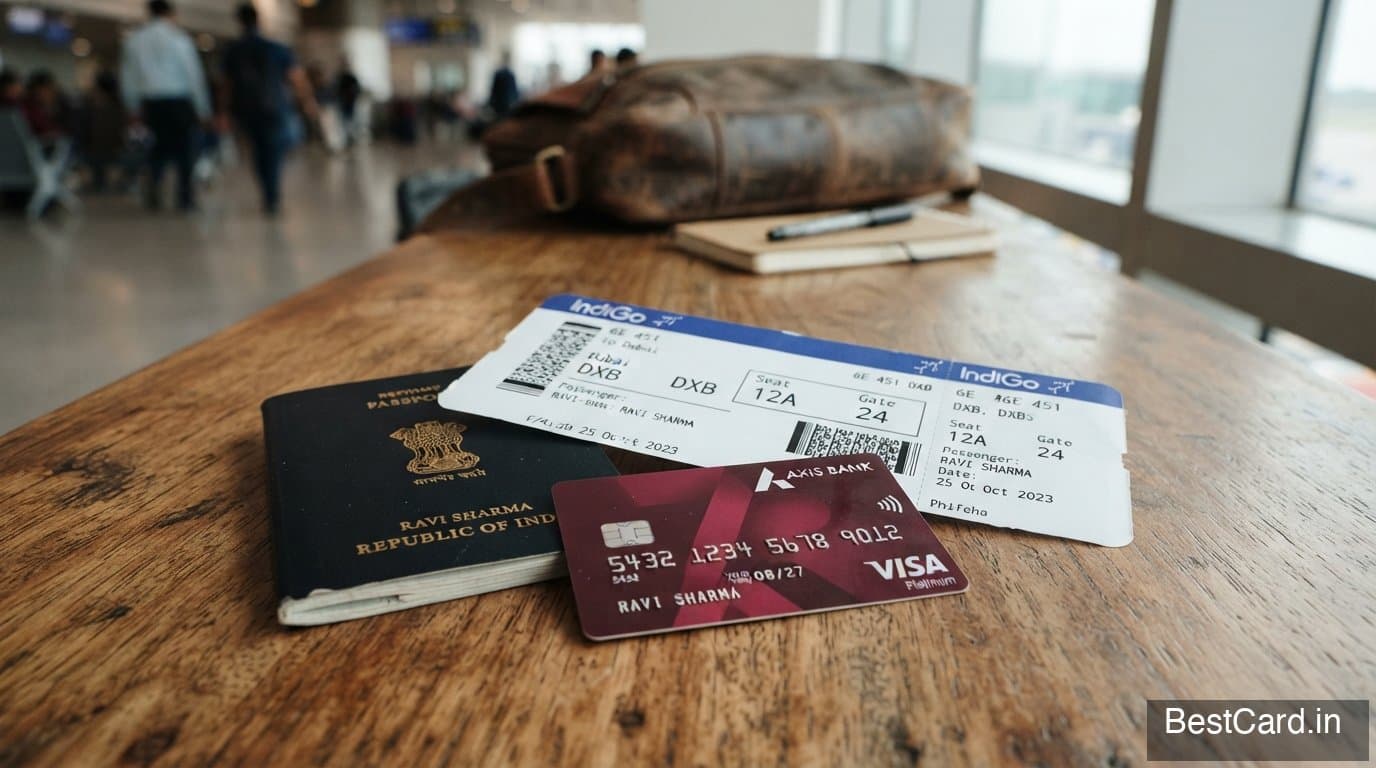
Every IDFC FIRST card on our list carries a 0% forex markup, including the lifetime-free ones. Axis Bank charges 3.5% on most of its cards and has to win on something else. It does, in a few places, but IDFC's foreign-spend advantage is hard to overlook.
Foreign spending: IDFC by a wide margin
The IDFC FIRST Select, Millennia, Classic and Wealth are all free, all with zero forex. The Select pays 4% on dining and travel, needs ₹1 lakh monthly income and gives one domestic lounge visit a quarter. One change to note: international spends stop earning reward points from 26 October 2026, so the zero markup is the benefit, not the points.
On Axis, the Atlas has a 3.5% forex markup, the Horizon 3.5% and the Select 3.5%. Only the Magnus (2%), Olympus (1.8%) and Reserve (1.5%) come lower, and they cost ₹12,500, ₹20,000 and ₹50,000. The Scapia Axis card, launched September 2026, has zero forex and is lifetime free.
IDFC leads, and not narrowly.
Premium travel cards
IDFC's Mayura is ₹5,999 with up to 16 domestic and 16 international lounge visits a year (unlocked by ₹20,000 monthly spend), 0% forex and a ₹2,08,333 monthly income requirement. The Ashva is ₹2,999 with four domestic and two international visits a quarter. The Diamond Reserve is ₹3,000, waived at ₹6 lakh, and rewards in-app travel bookings.
Axis's Atlas is ₹5,000 with 8 domestic and 4 international visits at Silver tier, rising to 18 and 12 at Platinum (₹15 lakh spend), and 5% on travel bookings. The Horizon is ₹3,000 and allows up to 8 domestic visits a quarter on the Visa variant, plus two international visits a quarter.
The Atlas earns miles transferable to airline and hotel partners, which we do not see on the IDFC cards. Ashva and Mayura win on cost per international lounge visit and forex. Call it even, split by whether you value transferable miles or lower costs abroad.

The flagship end
The Axis Magnus is ₹12,500, waived at ₹25 lakh of spend, with 12 EDGE points per ₹200, unlimited lounge access and a 2% forex markup. IDFC's top public cards are Mayura and Wealth. Its Gaj and Private are invite-only. Axis leads at the top for earning power.
Cashback, fuel and the cheaper end
Axis's ACE is a ₹499 RuPay card with 5% on utilities capped at ₹500 a month, 4% on dining and travel and 1.5% flat. The Flipkart Axis pays 5% on Flipkart up to ₹4,000 a quarter. IDFC's Hello Cashback is an FD-backed card at ₹1,000 with 5% on online shopping, with a 1% base rate.
On fuel, IDFC's Power+ is a ₹499 RuPay card with up to 6.5% at HPCL pumps, and the HPCL Power is ₹199. Axis's IndianOil card is ₹500 with 4% on fuel. IDFC leads on fuel; Axis leads on UPI-style cashback.
How to choose
For a traveller who wants the lowest costs abroad, IDFC's Ashva or Mayura. For someone chasing airline miles, Axis Atlas or Horizon. For a free card that does not tax foreign spends, IDFC Millennia or Select. For daily UPI-linked cashback, Axis ACE. If you plan to spend heavily and want the highest earn rate, Magnus.
Related reading
See the Axis Bank credit cards guide and the IDFC FIRST Bank credit cards guide. For IDFC against another mid-size bank, read Federal Bank vs IDFC FIRST credit cards.
Related reading
- Axis vs AU Small Finance Bank Credit Cards: Does AU Zenith Plus Undercut Atlas?
AU's Zenith Plus offers 16 domestic and 16 international lounge visits for ₹4,999, a pointed challenge to Axis Atlas. We compare it and the cheaper tiers.
- Axis vs RBL Credit Cards: Everyday Cashback Against RBL's Zero-Forex World Safari
Axis owns UPI and Flipkart cashback, RBL owns zero-forex travel cards and bigger fuel caps. We compare fees, rewards and lounge access across both lineups.
- Axis vs American Express Credit Cards: A ₹66,000 Charge Card Against Axis Reserve
Amex Platinum Charge costs ₹66,000, Axis Reserve ₹50,000. We compare their flagships, mid-tier travel cards and entry cards, plus where Amex gives less.