
IDFC FIRST Ashva Credit Card Review: A Zero-Forex Metal Card at a Mid-Tier Fee
2 May 2026 · BestCard Editorial Team
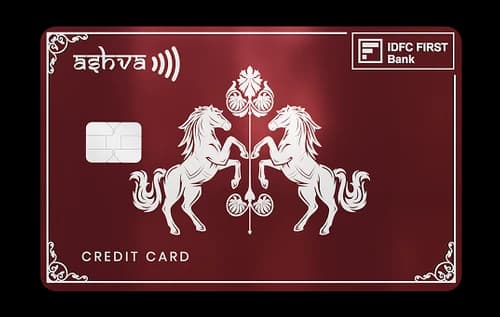
The IDFC FIRST Ashva Credit Card is a metal Visa Infinite travel card that does something unusual at its price: it charges a 0% forex markup for a ₹2,999 fee. Around that it builds a generous lounge allowance across airports and railway stations, monthly golf for active spenders, and trip cancellation cover. The reward rate is modest unless you spend more than ₹20,000 a month, so this isn't a card for maximising points. For anyone who spends money abroad, though, it's one of the best-value cards in its class.
Fees and eligibility at a glance
The joining fee and annual fee are both ₹2,999, with no spend-based waiver. Eligibility asks for a minimum monthly income of ₹1 lakh, or ₹12 lakh a year, a credit score of 700 or above, and an age between 21 and 60. Both salaried and self-employed applicants can apply.
The welcome benefit takes some of the sting out of the first year. You get up to 7,500 reward points on activation, worth ₹1,875 at ₹0.25 a point, or ₹3,000 if redeemed for travel through IDFC FIRST Travel & Shop at ₹0.40 a point. That covers most or all of the joining fee, but from year two the fee has to be justified by benefits alone.
Rewards and how they actually work
The base reward rate works out to about 0.83%. Normal spending earns at 5X, and monthly spends above ₹20,000 per statement cycle earn at 10X, roughly double the base rate. Points are worth ₹0.25 each, or ₹0.40 when redeemed for travel through IDFC FIRST Travel & Shop, so redeeming for travel improves your return by 60%.
To put the base rate in context, ₹20,000 of monthly spend earns about ₹166 a month in value. That's acceptable but unremarkable. Ashva earns its fee through its benefits, not its points.
Lounges, forex, golf and insurance
The lounge allowance is 4 domestic airport visits and 2 international airport visits every quarter, which adds up to 16 domestic and 8 international visits a year. On top of that you get 4 railway lounge visits a quarter, or 16 a year. For a couple who travels regularly, or a solo traveller who takes a trip most months, that's plenty.
The 0% forex markup is the main reason to get this card. If you spend ₹2 lakh abroad in a year, a typical 3.5% card adds ₹7,000 in markup. Ashva adds nothing, so the forex saving alone is more than twice the annual fee. It also helps with foreign-currency online purchases and overseas subscriptions.
Golfers get 2 complimentary rounds or lessons a month once monthly spend crosses ₹20,000. Trip cancellation cover reimburses up to ₹25,000, twice a year. And there's a buy-one-get-one offer on movie tickets through Zomato District, up to ₹400, twice a month, which is worth up to ₹800 a month if you use it.
How it compares with IDFC FIRST Mayura and Axis Horizon
The IDFC FIRST Mayura is the step up at ₹5,999. It keeps the 0% forex markup and raises the allowance to up to 16 domestic, 16 international and 16 railway lounge visits a year, but those visits are unlocked by ₹20,000 of monthly spend. It adds Cancel For Any Reason cover of up to ₹50,000 twice a year, values points at ₹0.50 for flights and hotels, and comes with a bigger welcome offer. It also needs ₹25 lakh of annual income. Unless you'll use more than eight international lounge visits a year, Ashva delivers most of Mayura's value for half the fee.
The Axis Horizon costs ₹3,000, waived at ₹3.5 lakh of annual spend. It earns EDGE Miles at 5% on travel and 2% elsewhere, far more than Ashva's base rate, and offers up to 32 domestic lounge visits a year on the Visa variant plus 8 international. But it charges a 3.5% forex markup. For someone who travels mostly within India and wants a strong earn rate, Horizon is the better card. For someone who spends meaningful amounts abroad, Ashva saves more.
What's genuinely good about this card
A true 0% forex markup at under ₹3,000 a year is the standout, and it can pay for the card several times over for regular international travellers. The lounge allowance covers domestic, international and railway lounges in good numbers. Monthly golf, trip cancellation cover and the movie offer add real value for people who use them. And at ₹12 lakh of annual income, the eligibility bar is far more reachable than Mayura's.
Where it falls short
The fee can't be waived through spending, so you pay ₹2,999 every year regardless of use. The base reward rate of about 0.83% is low, and the better 10X rate and the golf benefit both depend on crossing ₹20,000 a month. If you rarely travel abroad, the card's biggest advantage goes unused, and you'd be better off with a card that earns more on everyday spending.
Who this card actually makes sense for
Ashva suits salaried and self-employed professionals earning ₹12 lakh or more who travel abroad a few times a year, shop on international websites or pay for foreign subscriptions. It works best as a travel and forex card paired with a cashback card for daily spending. Domestic-only travellers should look at Horizon, and very frequent international flyers with higher incomes can consider Mayura.
Where to go from here
For the full IDFC FIRST lineup, read the IDFC FIRST Bank credit cards guide. Our best zero forex markup credit cards list compares Ashva with other forex-friendly cards, and the credit card railway lounge access guide explains how to use those station lounge visits.
Related reading
- IDFC FIRST Select Credit Card: A Deep Dive Review
IDFC FIRST Select is one of the few cards in India with a genuine lifetime-free option and no cap on reward point validity. Here's the full breakdown.
- IDFC FIRST SWYP Credit Card Review: Built for EMIs, Not for Reward Points
An honest review of the IDFC FIRST SWYP Credit Card: fee-based EMI conversion, monthly milestone points instead of a reward rate, railway lounges, and who should actually carry it.
- KrisFlyer SBI Card Review: Worth It for Occasional Singapore Airlines Flyers?
A review of the KrisFlyer SBI Card's direct miles earning, lounge access, and fees for Singapore Airlines and Scoot flyers.