Credit Card Upgrade vs Downgrade: How to Decide
9 July 2026 · BestCard Editorial Team
Most Indian issuers run their cards as a product family — an entry card, a mid-tier card, and a premium card, all sitting on the same underlying network and often the same core benefits structure. Moving between them, called upgrading or downgrading, is usually simpler than applying for a new card from scratch, but it's not automatically the right move just because it's available.
Why upgrade or downgrade instead of just applying fresh
Switching within the same issuer's family keeps your account tenure and credit history with that bank intact — you're not opening a new tradeline, which matters for your credit utilization ratio and the average age of your credit accounts. A new card application also triggers a fresh hard inquiry on your CIBIL report; an in-family upgrade or downgrade usually doesn't, or triggers a much lighter check, because the bank already has your full repayment history on file. This is the main reason issuers push these conversions actively rather than making you apply from scratch each time.
When an upgrade makes sense
An upgrade is worth taking when your spending has genuinely grown into the next tier's benefit structure — you're now spending enough on dining, travel, or general categories that the higher reward rate and added perks (lounge access, higher reward caps, better insurance cover) would outweigh the increased annual fee. Check the math the same way you would for any new card: compare the fee difference against the realistic annual value of the added benefits, not the advertised value. Our are premium cards worth the annual fee post has the framework for this.
Upgrades are also often available with a first-year fee waiver, especially when offered proactively by the bank or during a retention conversation — in that case, it's close to a free trial and worth taking to test the higher tier before committing long-term.
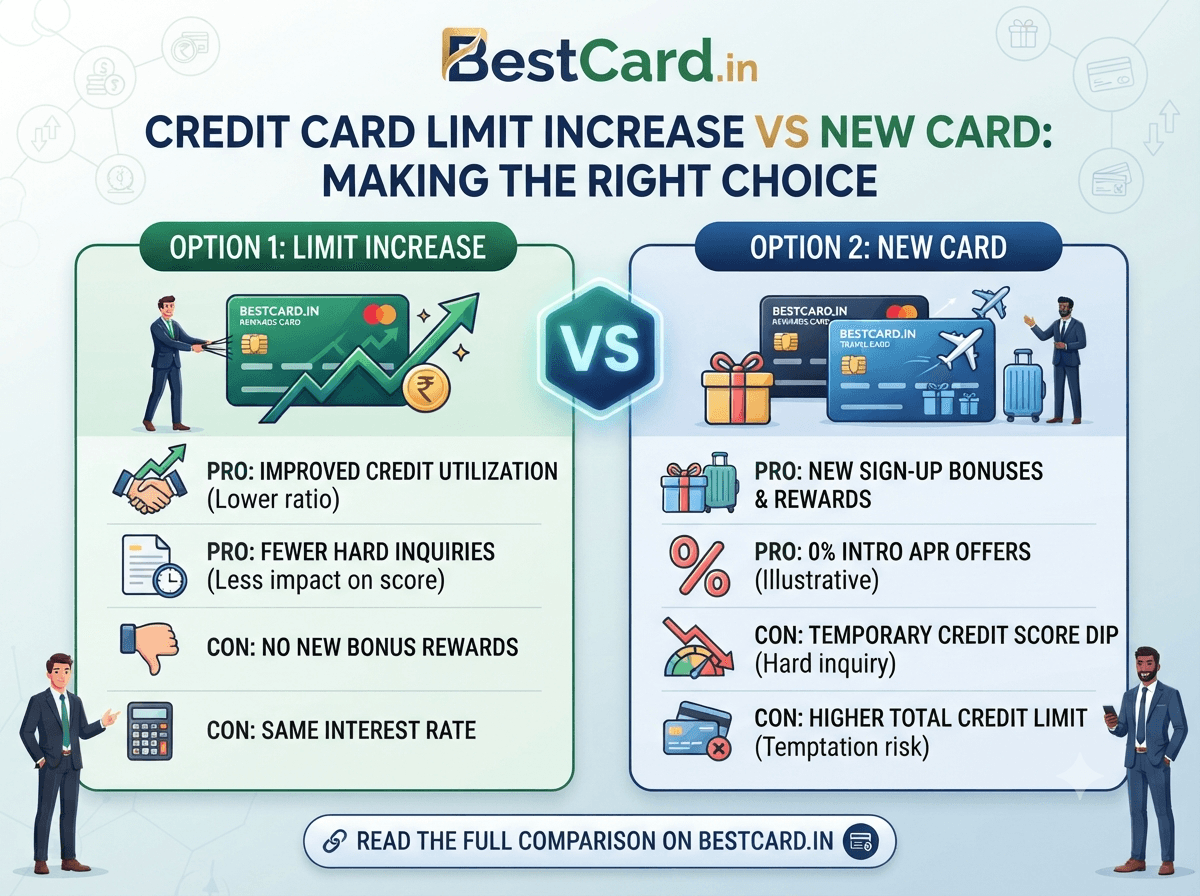
A credit limit increase almost always comes bundled with an upgrade too, since a higher-tier card typically ships with a materially higher limit. If limit alone is your goal without wanting a different fee or benefit structure, compare this against simply requesting a credit limit increase on your existing card, or weigh both against opening a second card via our limit increase vs new card comparison.
When a downgrade makes sense
Downgrading makes sense when your spending pattern has shifted away from what the card rewards, or when the annual fee has become hard to justify against actual usage — say, you stopped traveling and a travel-heavy premium card's lounge access and travel insurance are now going unused. A downgrade keeps the account open (preserving your credit history and average account age) while cutting the fee, which is almost always better for your score than closing the card outright, since closing reduces your total available credit limit and can spike utilization on your remaining cards.
Downgrading is also the sensible move if you're not ready to fully close a card but the fee negotiation and retention conversations (see our guides on fee negotiation and retention offers) didn't get you a waiver you're comfortable with — a downgrade to a lifetime-free or low-fee variant in the same family is a middle path between paying a fee you don't want and closing the account.
Credit limit and score implications
An upgrade generally raises your limit, which — assuming your spending doesn't rise proportionally — actually helps your utilization ratio by increasing the denominator. A downgrade can do the opposite: some issuers reduce your credit limit when you downgrade to a lower tier, which can push utilization up if your balances stay the same. Ask explicitly before downgrading whether the limit will change, and if it will drop significantly, pay down balances on other cards first so your overall utilization doesn't spike the same billing cycle.
Timing it around your renewal date
The best time to request either move is a few weeks before your annual fee renewal date, not right after it's charged. An upgrade requested proactively is more likely to come with a fee waiver on the new card's first year; a downgrade requested before renewal avoids paying the higher fee for a tier you're about to leave anyway. If you're already deep into negotiating the fee directly, as covered in annual fee negotiation tips, it's worth asking in the same call whether an upgrade or downgrade is a cleaner alternative to a straight waiver — retention agents can usually process either on the spot.
Where to go from here
If neither upgrading nor downgrading feels right and you're considering closing the card entirely, read how to close a credit card safely first — the order in which you close multiple cards matters for your score. And if you're deciding between staying within one issuer's family versus picking up an entirely different card, our how to pick a second credit card guide covers that broader decision.