
Credit Card Refund Timeline in India: How Long It Takes
27 September 2026 · BestCard Editorial Team
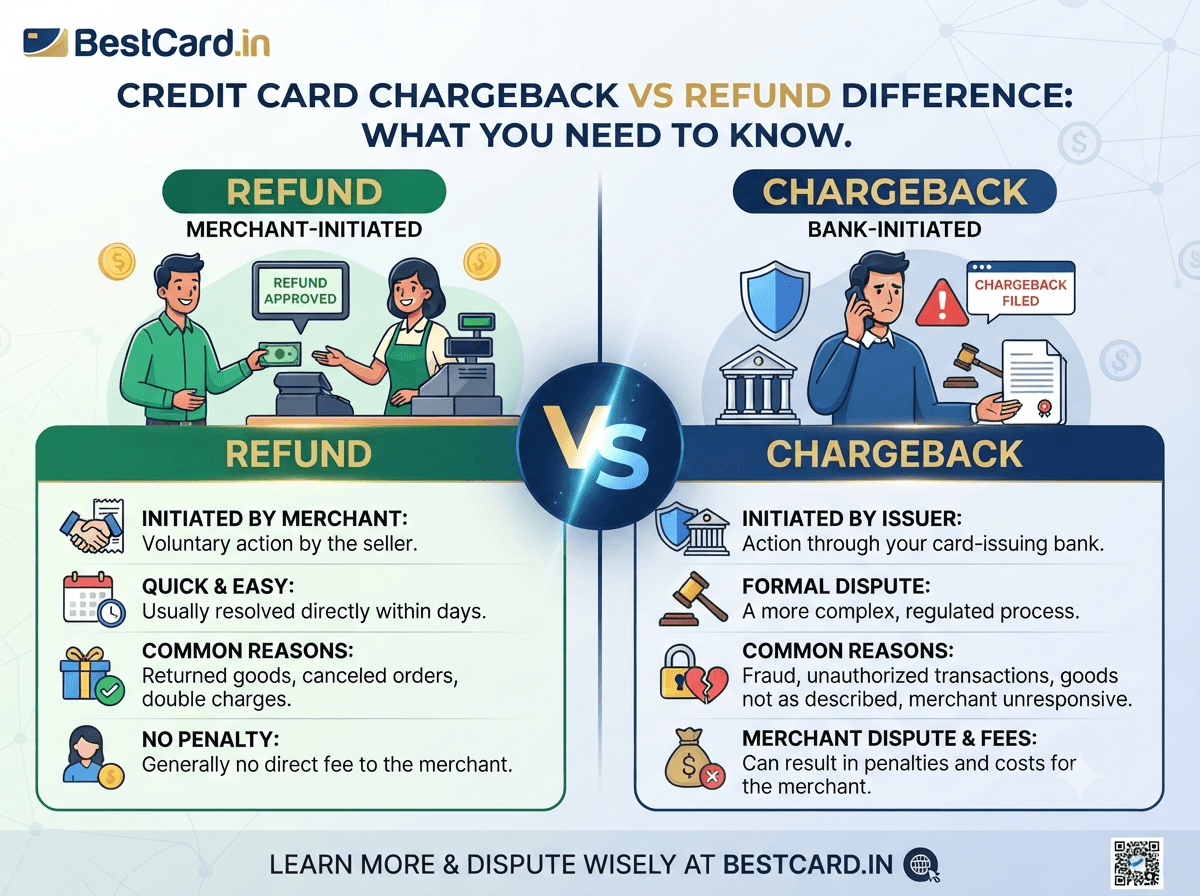
A credit card refund in India usually reaches your card about 5 to 7 working days after the merchant processes it. The real variable is the merchant: some start the refund the same day, others take a week or two to inspect a return. Failed transactions where money was debited but the purchase didn't go through follow stricter RBI timelines and should reverse automatically within a few days.
The three stages of a refund
Every refund moves through three hands, and delays can happen at each one.
- Merchant approval. The merchant decides to refund you after a return pickup, quality check or cancellation. This is where most of the waiting happens. A food order cancellation might be refunded in minutes; a returned laptop might take 7 to 10 days after pickup.
- Network processing. The merchant's bank (the acquirer) sends the refund through Visa, Mastercard, RuPay or Amex to your card issuer. This usually takes a few working days.
- Issuer posting. Your bank posts the credit to your card account. Most banks do this within a day or two of receiving it.
Add these up and you get the commonly quoted 5 to 7 working days after the merchant initiates the refund. Weekends and bank holidays don't count.
Typical timelines by situation
| Situation | What usually happens |
|---|---|
| Online order cancelled before dispatch | Merchant refunds quickly; credit in about 5–7 working days |
| Product returned after delivery | Clock starts after pickup and quality check; often 1–2 weeks in total |
| Flight or hotel cancelled by you | Depends on fare rules and the airline or OTA; can take longer |
| Flight cancelled by the airline | Airline must refund under DGCA rules; see our flight cancellation chargeback guide |
| Failed transaction (money debited, no purchase) | Auto-reversal under RBI's turnaround rules, typically within T+5 days |
| Duplicate charge | Often reverses on its own; raise a dispute if it doesn't |
| International merchant | Same process, but currency movements can change the rupee amount |
Failed transactions: what RBI requires
Failed transactions are not the same as refunds. If your card was charged but the purchase didn't go through, say a POS terminal timed out or an online payment failed after the debit, RBI's framework on turnaround times for failed transactions applies. Under it, the issuer has to reverse the amount within a fixed number of days (T+5 for card-not-present and POS failures, where T is the transaction date). If it misses that deadline, the bank owes you compensation for each day of delay.
These rules apply to genuine failures, not to merchant refunds where the purchase did go through. RBI updates these circulars from time to time, so check the current version on RBI's website or ask your bank to confirm the turnaround time that applies to your case.
How refunds show up on your statement
A refund appears as a credit line, usually marked "CR" or with a minus sign. Where it lands depends on timing:
- Before the statement date: it reduces the bill for that cycle.
- After the statement but before the due date: your statement still shows the original charge. Pay the amount due anyway; the refund will show on the next statement.
- After you've paid: you'll have a credit balance. It gets used up by your next purchases, or you can ask the bank to send it to your bank account.
Example. You buy a ₹24,000 phone on 3 March. Your statement is generated on 15 March and due on 4 April. You return the phone, and the merchant processes the refund on 28 March. The credit reaches your card around 5 April.
Your 15 March statement shows ₹24,000 due. If you pay it by 4 April, the ₹24,000 refund on 5 April becomes a credit balance. If you skip the payment expecting the refund, you'll pay a late fee plus interest, both with 18% GST, and that hit stays on your record. Our billing date vs due date explainer shows how these dates interact.
Refunds on EMI purchases
If you converted a purchase to EMI and then returned it, the refund closes the EMI. Expect:
- The outstanding principal to be cleared by the refund.
- Interest already billed to stay billed, though some banks reverse it on request.
- The processing fee, and the GST on it, usually not to be refunded.
- A possible foreclosure charge on some cards; see EMI foreclosure charges.
On no-cost EMI, the merchant's upfront discount is also reversed, so check the final figures carefully.
Refunds and reward points
Banks reverse rewards on refunded purchases. Cashback earned on a ₹10,000 purchase at 5% (₹500) will be clawed back when the ₹10,000 is refunded. If you already redeemed the points, some banks deduct them from your balance, which can go negative. This catches people out on cards with high category rates, like the SBI Cashback Card or Flipkart Axis Bank Card.
International refunds and currency
If you get a refund from a foreign merchant, it's converted to rupees on the day the refund is processed, not the day you paid. If the rupee has moved, the refund can be slightly more or less than you paid. Whether the forex markup and the GST on it are refunded varies by bank. A zero-forex card like the Niyo Global avoids that question entirely.
What to do if your refund is late
- Get proof from the merchant. Ask for the refund reference number, ARN (Acquirer Reference Number) or RRN. The ARN lets your bank trace the credit through the network.
- Wait the standard window. Give it 7 working days from the date the merchant says it processed the refund.
- Call your card issuer with the ARN. Most "missing" refunds are found at this stage.
- Raise a dispute. If the merchant hasn't refunded, or the bank can't find it, file a dispute. Our guide to the dispute and chargeback process explains the steps, and chargeback vs refund explains how the two differ.
- Escalate. If the bank doesn't resolve it, escalate to its grievance officer, then to the RBI Ombudsman through the RBI's complaint portal.
Common mistakes
- Not paying the bill while waiting for a refund.
- Not saving the refund confirmation and ARN.
- Raising a chargeback before the merchant has had a fair chance to refund, which can slow things down.
- Forgetting that the reward points will be reversed.
The bottom line
Allow about a week once the merchant confirms the refund, keep paying your bill on schedule, and use the ARN if anything goes missing. Card names and rates above are from BestCard's latest card data, and issuers change terms often, so check the issuer's site before you apply for any card. If you want a card with stronger dispute support or better online rewards, the card matcher can shortlist one for you.
Frequently asked questions
How many days does a credit card refund take in India?
Once the merchant processes the refund, it usually reaches your card in about 5 to 7 working days. The total wait depends mostly on how long the merchant takes to start the refund, which can be anything from same-day to a couple of weeks.
What if the refund comes after I've paid my bill?
The refund sits on your card as a credit balance and is adjusted against your next purchases. You can also ask the bank to transfer the credit balance to your bank account.
Should I pay my credit card bill if a refund is pending?
Yes. Pay at least the full amount due by the due date. If the refund arrives later, it becomes a credit. Not paying can trigger interest and a late fee, which the refund won't reverse.
What happens to reward points when I get a refund?
Banks reverse the points or cashback earned on the original purchase. If the points were already redeemed, the bank may deduct them from your balance or charge their value.
Related reading
- Dynamic Currency Conversion Explained: Always Pay Local
Dynamic currency conversion explained: why paying in rupees abroad costs more, a worked example, how to spot DCC at terminals and ATMs, and which cards help.
- Credit Card Utility and Education Transaction Fees Explained
How credit card fees on utility bills and education payments work in India, when they apply, how GST adds to them, and practical ways to avoid or reduce them.
- Can You Pay a Mutual Fund SIP with a Credit Card in India?
Can you pay a mutual fund SIP with a credit card? Why AMCs and apps say no, the costly workarounds to avoid, and a smarter way to use your card for investing.