
Best Credit Cards for a USA Trip from India (2026)
3 October 2026 · BestCard Editorial Team
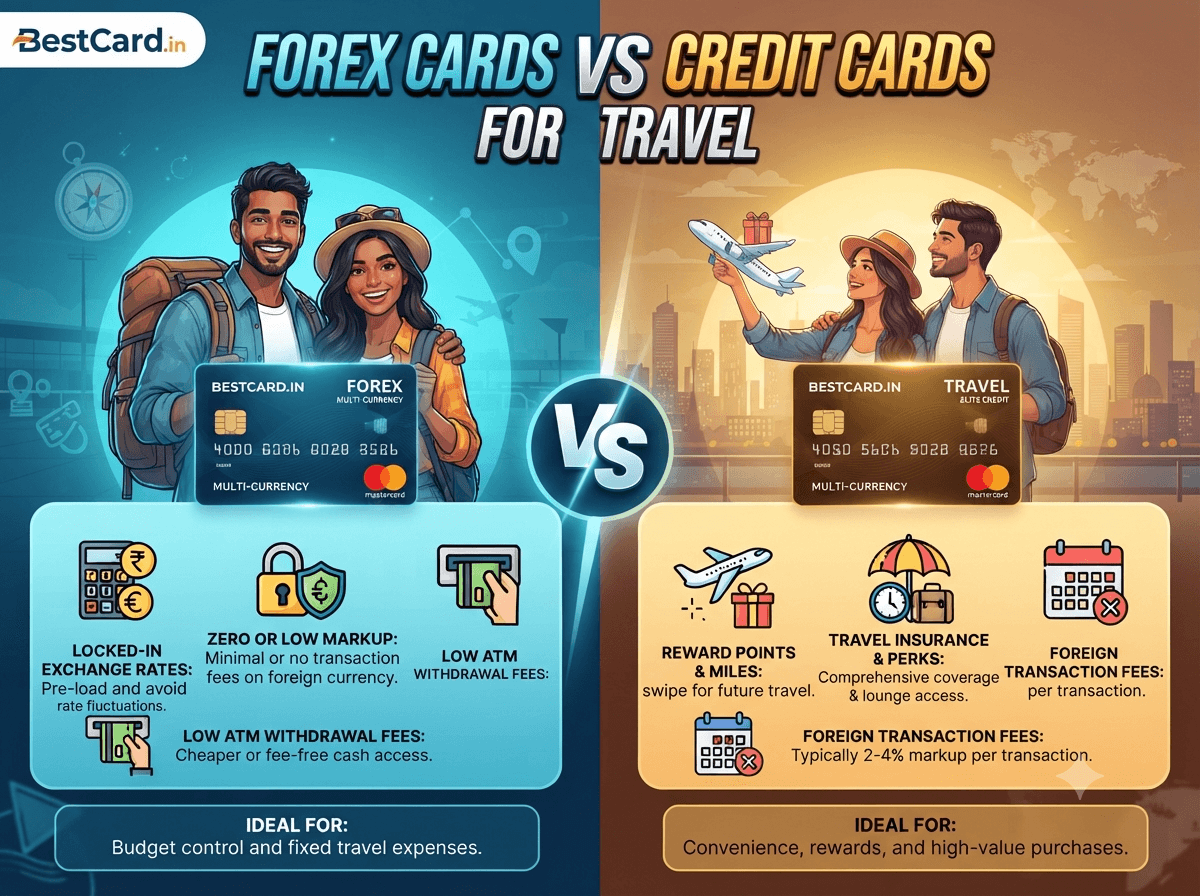
The best credit cards for a USA trip from India are zero or low-forex markup cards on Visa or Mastercard: Federal Bank Scapia and Niyo Global if you want a free card, RBL World Safari or AU Zenith+ if you also want lounge access and travel benefits, and Axis Magnus if you're a high spender who wants unlimited lounges. On a typical two-week US trip, the difference between a 3.5% card and a 0% card can easily run past ₹10,000.
Here's the shortlist, the maths and a few US-specific quirks worth knowing before you fly.
What matters for a US trip
- Forex markup. The biggest cost. Hotels, car rentals, restaurants and shopping in the US add up quickly, and every rupee carries the markup plus 18% GST.
- Network. Visa and Mastercard are accepted almost everywhere. Amex works in most places. RuPay acceptance is patchy.
- Lounge access. Flights from India to the US are long, often with a layover in the Gulf or Europe. International lounge access is useful on these routes.
- Credit limit headroom. US hotels and car rental firms place deposits (holds) on your card that can block a large chunk of your limit for days.
Shortlist at a glance
| Card | Annual fee | Forex markup | International lounge | Min. income (monthly) |
|---|---|---|---|---|
| Federal Bank Scapia | Free | 0% | None (domestic only) | ₹25,000 |
| Niyo Global | Free | 0% | None | Not listed |
| IDFC FIRST Wealth | Free | 0% | 1 a quarter (₹20,000 monthly spend) | ₹3,00,000 |
| RBL World Safari | ₹3,000 | 0% | 2 a year via Priority Pass | ₹40,000 |
| AU Zenith+ | ₹4,999 | 0.99% | 16 a year via Priority Pass | ₹80,000 |
| Axis Magnus | ₹12,500 | 2% | Unlimited via Priority Pass | ₹2,00,000 |
The cards in detail
Federal Bank Scapia: best free card for most travellers
Lifetime free with 0% forex markup, which is rare at this price. You earn Scapia Coins worth about 2% on eligible spends and about 4% on flights and hotels booked in the Scapia app, redeemable against travel in the app. Unlimited domestic lounge access kicks in with ₹5,000 of monthly spend, which helps on your departure from India. No international lounges.
Niyo Global: simplest zero-markup backup
Free, 0% forex markup, and markup-free ATM withdrawals abroad through the linked Niyo account. Rewards are minimal and there's no lounge access, so treat it as a no-cost spending card or a backup.
IDFC FIRST Wealth: free premium card for high earners
0% forex markup on a lifetime-free card, plus travel insurance, trip cancellation cover of up to ₹10,000 and one international and one domestic lounge visit a quarter (unlocked by ₹20,000 of spend in the month). Note that from 26 October 2026, international spends stop earning reward points on this card, so its US value comes from the zero markup and the insurance. The ₹3 lakh monthly income bar limits who can get it.
RBL World Safari: best mid-range travel card
0% forex markup, 5% back on travel, a Priority Pass with 2 international lounge visits a year, and complimentary travel insurance of USD 100,000. The ₹3,000 fee is waived at ₹3 lakh of annual spend, and there's a MakeMyTrip voucher worth ₹3,000. The domestic lounge visits need ₹35,000 of spend in the previous quarter. Our RBL World Safari review has the details.
AU Zenith+: best for lounge-heavy long-haul travel
A 0.99% markup, 16 domestic and 16 international lounge visits a year, quarterly Airport Meet & Assist and up to 16 buy-one-get-one movie tickets. It earns 2% on travel and dining. The ₹4,999 fee comes with ₹5,000 of luxury vouchers on activation and is waived at ₹8 lakh of annual spend. If you fly via a hub with a layover, the lounge allowance is the standout.
Axis Magnus: for high spenders
The 2% markup isn't the lowest, but the 4.8% base reward rate (12% on travel) at 20 paise per point offsets it for people who transfer points to airline partners. Unlimited international lounge access via Priority Pass plus 4 guest visits a year makes it the most comfortable long-haul card on this list. Apply for Axis Magnus if you clear the ₹2 lakh monthly income bar.
The markup maths on a ₹3 lakh trip
Say you spend ₹3 lakh on hotels, food, transport and shopping during a two-week US trip.
| Markup | Markup cost | GST at 18% | Total extra cost |
|---|---|---|---|
| 3.5% (typical card) | ₹10,500 | ₹1,890 | ₹12,390 |
| 2% (Magnus) | ₹6,000 | ₹1,080 | ₹7,080 |
| 0.99% (AU Zenith+) | ₹2,970 | ₹535 | ₹3,505 |
| 0% (Scapia, Niyo, Wealth, World Safari) | ₹0 | ₹0 | ₹0 |
Switching from a typical card to a zero-markup card saves about ₹12,000 on this one trip. Figures reflect BestCard's latest card data, but issuers change markups and benefits, so verify on the issuer's site before applying. For a wider list, see our best zero forex markup credit cards.
US-specific tips
- Enable international usage before you leave. Indian cards ship with international transactions switched off. Turn them on in your card app and set sensible limits. Our guide to international transaction controls walks through it.
- Pay in US dollars, never rupees. If a terminal or website offers to charge you in INR, decline. That's dynamic currency conversion, and the rate is almost always worse. See our DCC explainer.
- Expect holds. Hotels and car rentals pre-authorise a deposit that can stay on your card for several days after checkout. Keep spare credit limit, or use a second card for deposits.
- Pay inside at gas stations. Pay-at-pump terminals ask for a US ZIP code. Indian cards won't pass that check.
- Tips are added after the swipe. At sit-down restaurants, you'll often sign a slip with a tip line after the card is authorised. Check the final amount on your statement.
- Carry two cards on different networks. A Visa and a Mastercard cover almost every situation if one gets blocked for fraud checks.
You won't pay TCS on these card spends under current rules. Our TCS on international credit card spends explainer covers why, and how that differs from forex cards.
How to choose
- Occasional traveller, no fees wanted: Federal Bank Scapia, with Niyo Global as a backup.
- Want lounges and insurance on a mid-range fee: RBL World Safari.
- Long-haul with layovers, value lounges: AU Zenith+.
- High income, high spend: Axis Magnus, or IDFC FIRST Wealth for zero markup on a free card.
The bottom line
For a US trip, the forex markup matters more than anything else. Carry at least one zero or low-markup Visa or Mastercard, add a lounge card if you're flying long-haul, and always pay in dollars. To find the best fit for your travel and income, use the BestCard matcher.
Frequently asked questions
Which Indian credit card is best for use in the USA?
A zero or low-forex card on Visa or Mastercard. In BestCard's data, Federal Bank Scapia, Niyo Global, IDFC FIRST Wealth and RBL World Safari charge 0% forex markup, and AU Zenith+ charges 0.99%. Pick based on whether you also want lounge access and rewards.
Will my RuPay credit card work in the USA?
Acceptance is limited. RuPay works on some international networks through partnerships, but for a US trip carry a Visa or Mastercard as your main card and treat RuPay as a backup at best.
Is TCS charged on credit card spends in the USA?
Not under current rules. International credit card spending while abroad is not counted under LRS, so TCS does not apply. You still pay the forex markup and 18% GST on it.
Why does my card get declined at US gas pumps?
Pay-at-pump terminals usually ask for a US ZIP code, which Indian cards can't match. Pay inside the station instead, or ask the cashier to pre-authorise a fixed amount.
Related reading
- Best Credit Cards for a Thailand Trip in 2026 (Low Forex Picks)
Best credit cards for a Thailand trip in 2026: zero and low forex markup cards like Scapia, AU ixigo and RBL World Safari, with lounge access and rupee maths.
- Best Credit Cards for a Europe Trip in 2026: Low Forex Picks
The best credit cards for a Europe trip in 2026: zero and low forex markup cards, lounge access, travel cover and the payment habits that save money abroad.
- Best Credit Cards for a Singapore Trip from India (2026)
Best credit cards for a Singapore trip: zero and low forex markup picks, KrisFlyer miles cards, lounge access and a worked example of what forex costs.