How the Credit Card Interest-Free Period Actually Works
19 April 2026 · BestCard Editorial Team
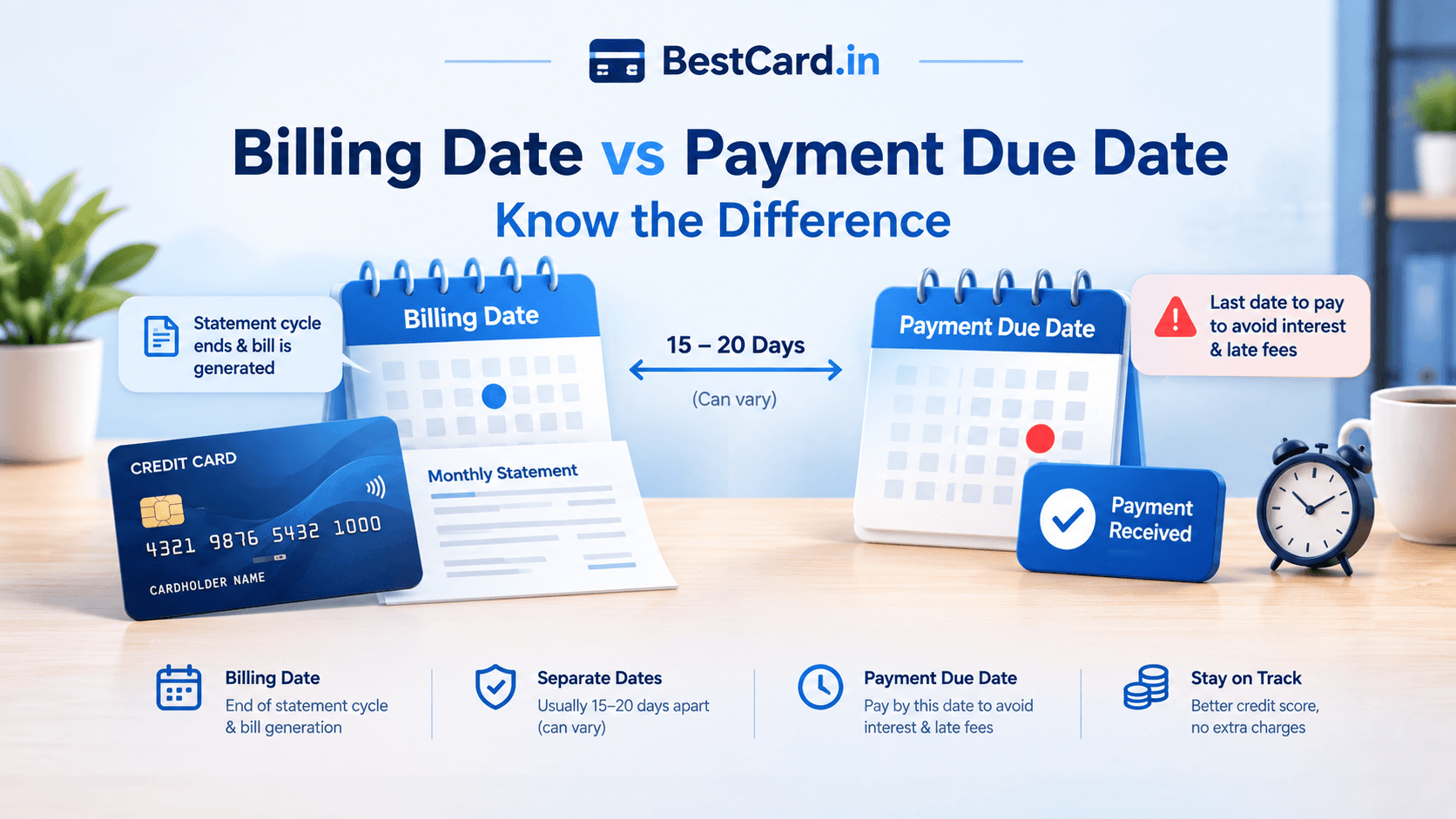
Most people know their credit card has an "interest-free period" in the vague sense that if you pay on time, you don't get charged interest. Far fewer understand the actual mechanics well enough to predict, transaction by transaction, whether a specific purchase will or won't attract interest — and that gap is where a surprising number of people end up paying interest on a card they were certain was interest-free. This goes deeper than our grace period explainer — specifically into the parts that trip people up: partial payments, EMI conversion, and the assumptions that feel obviously true but aren't.
The mechanic, precisely
The interest-free period isn't a fixed number of days from your purchase — it's the gap between your purchase date and your payment due date, which means it varies transaction by transaction within the same billing cycle. A purchase made the day your statement generates gets close to the maximum window (typically 45-50 days depending on the issuer). A purchase made the day before your next statement generates gets close to the minimum (often as short as 18-20 days). This is why "my card has a 50-day interest-free period" is a marketing simplification, not a transaction-level guarantee — our billing cycle explainer and due date vs billing date guide break down exactly how the cycle boundaries create this variation.
The interest-free period only applies at all if you paid your previous statement's total amount due in full, by its due date. This is the part that gets misunderstood most.
How partial payments kill the interest-free period entirely
Here's the mechanic that catches people off guard: paying anything less than the full statement balance — even 95% of it — doesn't give you a prorated interest-free period on the remaining 5%. It removes the interest-free period from the entire balance, including new purchases made in the current cycle that haven't even appeared on a statement yet.
Concretely: say your statement total is ₹50,000, and you pay ₹45,000, leaving ₹5,000 unpaid. Most people assume interest accrues only on that ₹5,000. It doesn't work that way. Because you didn't pay the statement in full, the card issuer treats your account as having lost its grace period, and interest starts accruing from the transaction date — not the due date — on every new purchase you make going forward, until you pay a full statement balance again and the interest-free period resets. Your new purchases this month, made in good faith with no intention of carrying a balance, are quietly accruing interest from day one because of an unrelated partial payment last cycle.
This is arguably the single most expensive misunderstanding in credit card use, because it looks like responsible behavior — you paid most of the bill — while actually costing you close to the same interest as paying the statutory minimum due. Our minimum due vs total due mistake guide and minimum due trap explainer cover the adjacent version of this same trap in more detail.
How EMI conversion interacts with the interest-free period
Converting a large purchase to EMI removes that specific transaction from the interest-free-period calculation entirely and puts it on its own separate repayment track, with its own processing fee and its own interest rate (for non-zero-cost EMI plans) baked into the installment structure. This has two consequences people often miss.
First, converting one purchase to EMI does not affect the interest-free period on the rest of your card's spending — your other purchases still get a normal grace period as long as you pay the remaining statement balance (EMI installment plus everything else non-EMI) in full each cycle. Second, and less obviously: if you're carrying an EMI conversion and you fail to pay the rest of your statement in full, the interest-free-period loss applies to your regular spend exactly as described above, while the EMI itself continues on its separate fixed schedule regardless. The two tracks don't cross-contaminate each other's terms, but a mismanaged regular balance can absolutely coexist with a perfectly on-track EMI, giving a false sense that "the big purchase is handled" while smaller spend quietly racks up interest. Our EMI conversion guide covers the cost structure of EMI conversion itself in more depth, including when zero-cost EMI is genuinely zero-cost and when it isn't.
Cash withdrawals never get an interest-free period
Worth stating plainly because it's a common point of confusion: ATM cash withdrawals on a credit card are never covered by the interest-free period, regardless of your payment history. Interest accrues from the moment of withdrawal, plus a separate cash advance fee on top. This is structurally different from purchase spend and doesn't respond to any of the usual grace-period logic — see our cash withdrawal guide for the full cost breakdown.
The misunderstandings that cost people money, summarized
The most common one is assuming a partial payment prorates the interest-free loss — it doesn't, it removes the grace period from everything until a full payment resets it. The second is assuming the interest-free period is a fixed number of days from purchase, when it's actually a floating window that shrinks the closer your purchase falls to your next statement date. The third is assuming EMI conversion "protects" your interest-free period on the rest of your spending in some blanket way, when really the two just run on independent tracks and neither bails out the other.
The practical rule
Pay your full statement balance, every cycle, no exceptions, or accept upfront that you've forfeited the interest-free period on everything until you do. If a purchase is too large to pay off in one cycle, converting it to EMI deliberately — with a known fee and a fixed schedule — is a more controlled decision than letting it sit as a partial payment and silently costing you interest on transactions you thought were free. If you're new to managing a card, pairing this with our first credit card guide is worth the extra ten minutes before you start relying on the interest-free period as a given.